Vectors

- The points
and D have coordinates and respectively. If what are the values of and ?
Solutions
Compute the vectors
and
The condition
Solving these,
- Points A and B have coordinates
and respectively. If point is such that , what are the coordinates of ?
Solutions
Points
Since
Rearrange to solve for
With
hence
A quick check:
Therefore,
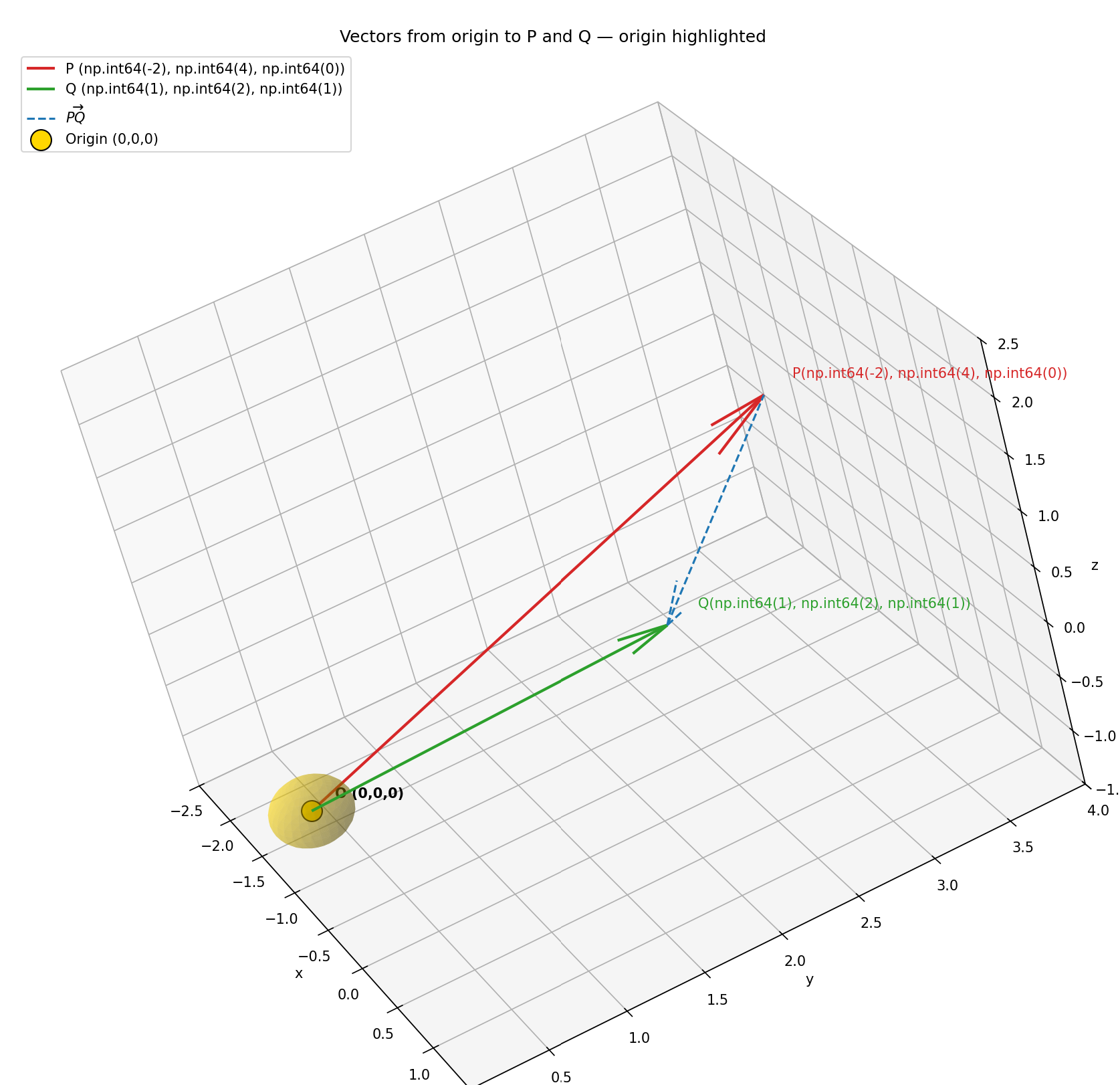
- The point P has coordinates (
).
The point Q is such that.
The point R has coordinates.
For which value ofis PQR an equilateral triangle?
Hint
Solutions
The given points are
Hence
Compute the squared length of
Thus every side of the equilateral triangle must have squared length
Compute squared lengths to
For
From the first equation:
From the second equation:
The only value common to both sets is
Check: for
so all three sides have squared length
Therefore,
- Point
has coordinates ( ). Point B has coordinates ( ). Find the point C so that and are in the same direction and .
Solutions
Compute the direction vector:
Let
Compute the length of
Hence
So
and therefore
Quick check:
Therefore,
- Forces
and , where and are scalars, act on a box. Prove that it is not possible for their resultant force to act in the direction of .
Solutions
Let
For
Subtracting the second equation from the first gives
so
This means the resultant force is zero vector, and contradicts the requirement that it acts in the direction of
- The points
and R have position vectors and .
(a) Show that the triangle PQR is isosceles.
Solutions
The position vectors of
Compute the side vectors:
Compute squared lengths to avoid unnecessary square roots:
Since
so two sides of triangle
(b) M is the midpoint of QR . Find the position vector of M .
Solutions
Midpoint formula:
Hint
The area of triangle PQR is given by half of magnitude of the cross product of two side vectors:
So try to Calculate the cross product
Solutions
Given
Their cross product is
so its magnitude is
The area of triangle PQR is half this magnitude:
- The points
and D have position vectors and .
(a) Write down the vector.
Solutions
(b) Calculate the length BC
Solutions
The position vectors are
The vector
The length of
Therefore the length
Hint
Calculate the vectors
Solutions
Note that
so opposite sides are parallel.
Compute the side lengths:
and
similarly
All four sides are equal in length and opposite sides are parallel; hence ABCD is a rhombus.