Model for Friction

- A box is at rest on a rough horizontal floor. A horizontal force of 400 N acts on the box and the box is on the point of moving. The coefficient of friction between the box and the floor is 0.65 . Calculate the weight of the box.
Hint
Simply use the friction formula
Solutions
To find the weight of the box, we first need to determine the normal reaction force
where
Given that the box is on the point of moving, the applied force of 400 N is equal to the maximum frictional force:
Given that the box is on the point of moving, the applied force of 400 N is equal to the maximum frictional force:
Solving for
The normal reaction force
Therefore, the weight of the box is approximately
- In the system below, the coefficient of friction between the block and the table is 0.2 .
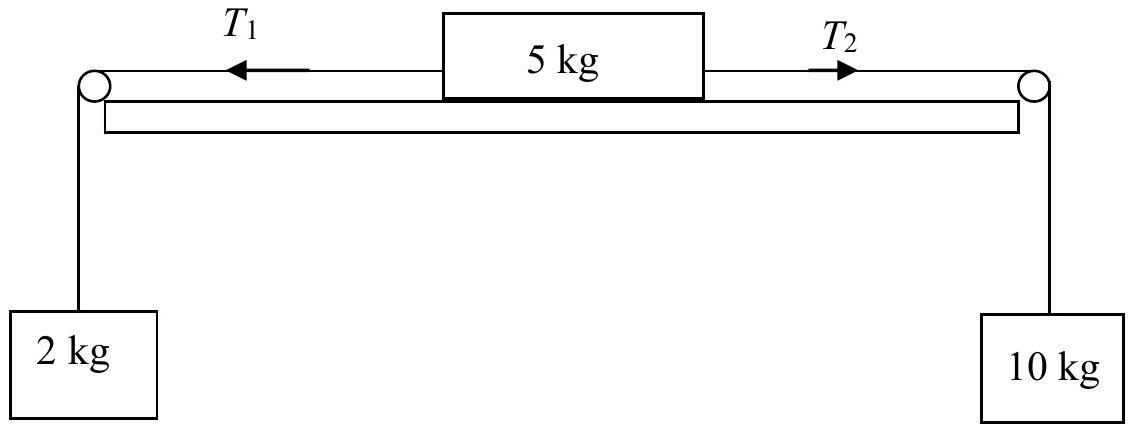
Find the acceleration of the system and the tensionsand .
Hint
Firstly, we need to decide the direction of acceleration. Since 10kg is heavier than 2kg + 5kg, the system will accelerate such that the 10kg block moves downward, while the 2kg and 5kg blocks move to the right.
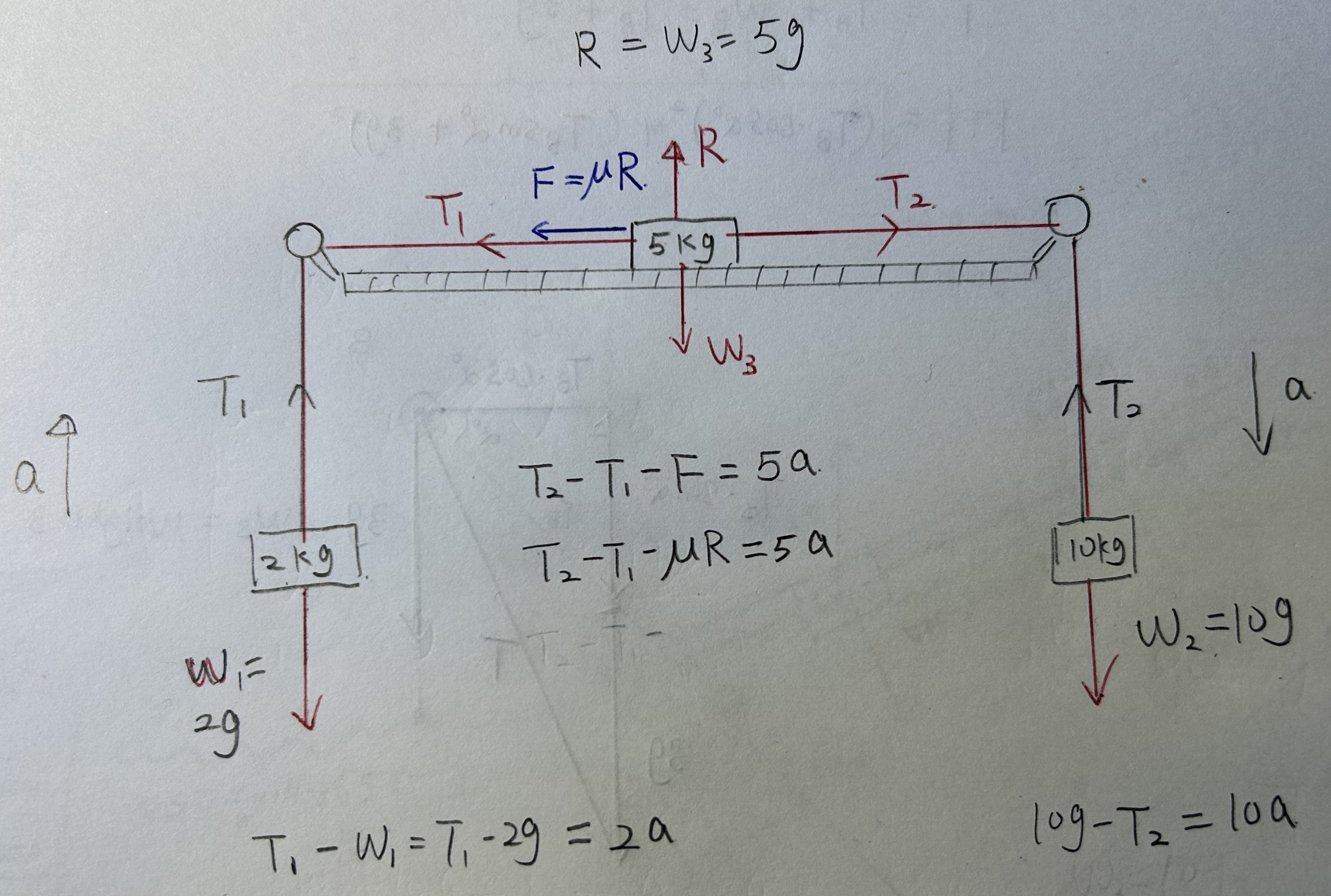
Then the key is to use Newton’s second law
Net force on 2kg box = T1 - weight of 2kg box = 2a
Net force on 5kg box = T2 - T1 - frictional force = 5a
Net force on 10kg box = weight of 10kg box - T2 = 10a
Net force on 2kg box = T1 - weight of 2kg box = 2a
Net force on 5kg box = T2 - T1 - frictional force = 5a
Net force on 10kg box = weight of 10kg box - T2 = 10a
We can solve these simultaneous equations to find the acceleration
Solutions
Firstly, we need to decide the direction of acceleration. Since 10kg is heavier than 2kg + 5kg, the system will accelerate such that the 10kg block moves downward, while the 2kg and 5kg blocks move to the right.
Then the key is to use Newton’s second law
Net force on 2kg box = T1 - weight of 2kg box = 2a
Net force on 5kg box = T2 - T1 - frictional force = 5a
Net force on 10kg box = weight of 10kg box - T2 = 10a
Net force on 2kg box = T1 - weight of 2kg box = 2a
Net force on 5kg box = T2 - T1 - frictional force = 5a
Net force on 10kg box = weight of 10kg box - T2 = 10a
Friction force on 5kg block = coefficient of friction × normal reaction = 0.2 × 5g = 0.2 × 5 × 9.8 = 9.8 N
We can solve these simultaneous equations to find the acceleration
If
- A small object of mass 4 kg is placed on a plane inclined at
to the horizontal. It is held in place by a light inextensible string that is parallel to the plane, passes over a smooth pulley and is attached to a sphere of mass which hangs freely as shown in the diagram.
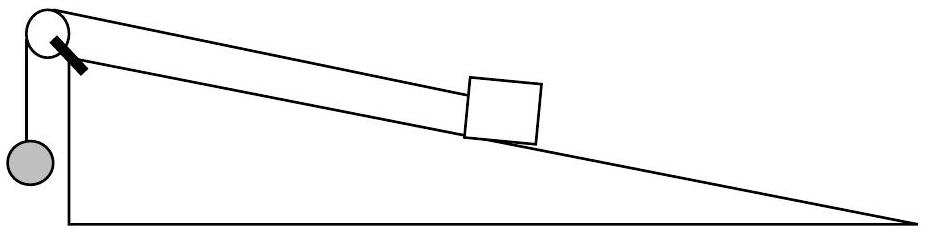
(a) Rishi models the system with the modelling assumption that the plane is smooth. Calculate the value offor the system to be in equilibrium.
Hint
Solutions
To find the value of
For the object on the inclined plane:
For the object on the inclined plane:
- The weight of the object is
- The component of the weight acting down the plane is
- The tension in the string
acts up the plane.
For the hanging sphere: - The weight of the sphere is
- The tension in the string
acts upward.
For equilibrium, the forces must balance:
- For the object on the inclined plane:
- For the hanging sphere:
Setting the two expressions for
Solving for
Calculating
Thus,
(b) Rishi finds that the system is in equilibrium when the mass of the sphere is 2.8 kg . He improves his model by modelling the plane as rough with coefficient of friction
Hint
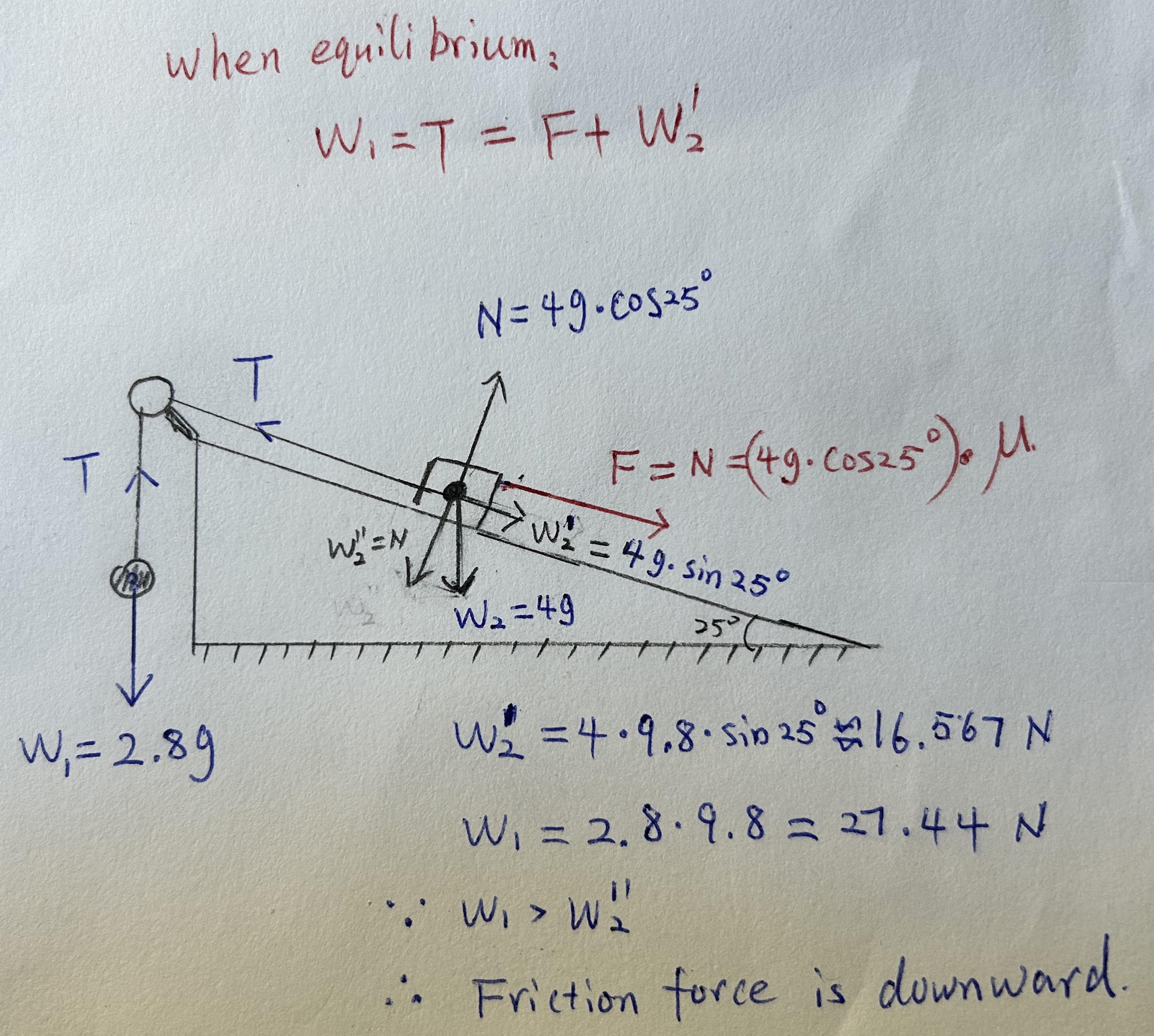
Need to decide the direction of frictional force first. Since the hanging mass is heavier than the previous case, the frictional force must act up the plane to prevent the object from sliding down.
Then set up the equations of equilibrium considering friction:
-
For the object on the inclined plane:
-
For the hanging sphere:
Then solve for
Solutions
To find the range of values for the coefficient of friction
For the object on the inclined plane:
For the object on the inclined plane:
- The weight of the object is
- The component of the weight acting down the plane is
- The normal reaction force
is given by - The frictional force
acts up the plane and is given by - The tension in the string
acts up the plane.
For the hanging sphere: - The weight of the sphere is
- The tension in the string
acts upward.
For equilibrium, the forces must balance:
- For the object on the inclined plane:
- For the hanging sphere:
Setting the two expressions for
Solving for
Calculating this gives:
Therefore, the range of values for
- The diagram shows a mass of 50 kg on a slope which makes an angle of
with the horizontal. The coefficient of friction between the mass and the slope is 0.25 . You may assume that the mass does not tip up.
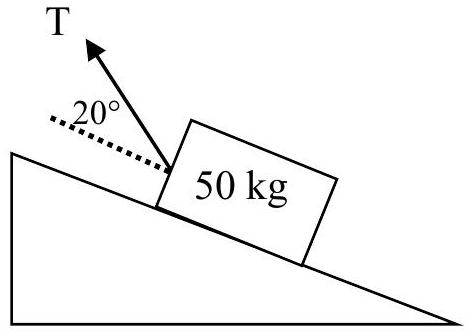
Find the magnitude of the forceif
(a) the mass is about to move down the slope
Hint
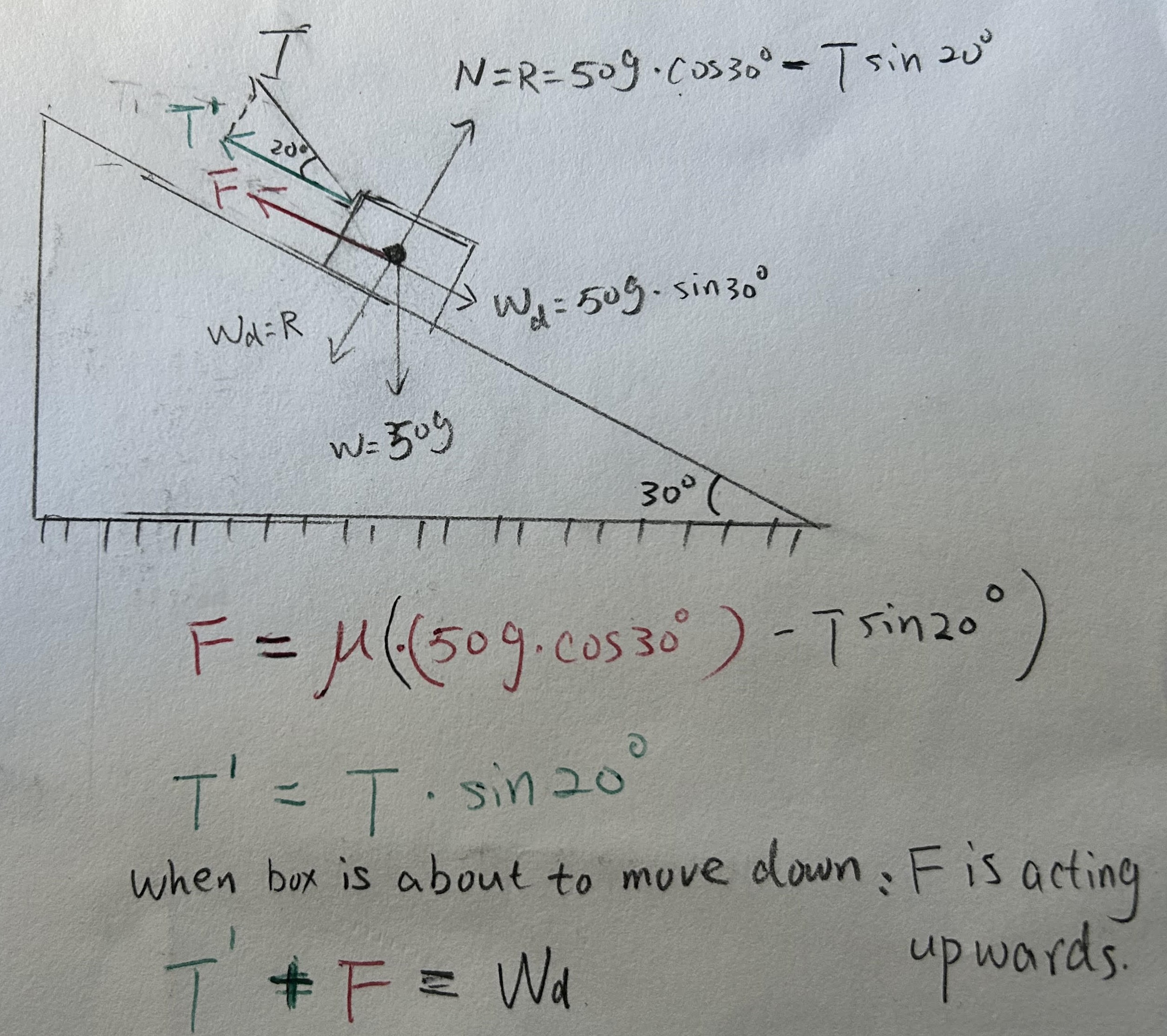
When the mass is about to move down the slope, the frictional force acts up the slope. Also the Reaction force need to consider the component of T perpendicular to the slope.
Solutions
To find the magnitude of the force
First, we calculate the weight of the mass:
First, we calculate the weight of the mass:
Next, we resolve the weight into components parallel and perpendicular to the slope:
- The component of the weight acting down the slope is:
- The normal reaction force
is:
The maximum frictional force
the component of T alone the slope is:
When the mass is about to move down the slope, the frictional force acts up the slope, and the equation of motion along the slope is:
Substituting the values we have:
Solving for
Calculating the right side:
Now, solving for
Calculating the left side coefficient:
Thus,
(b) the mass is accelerating at
Hint
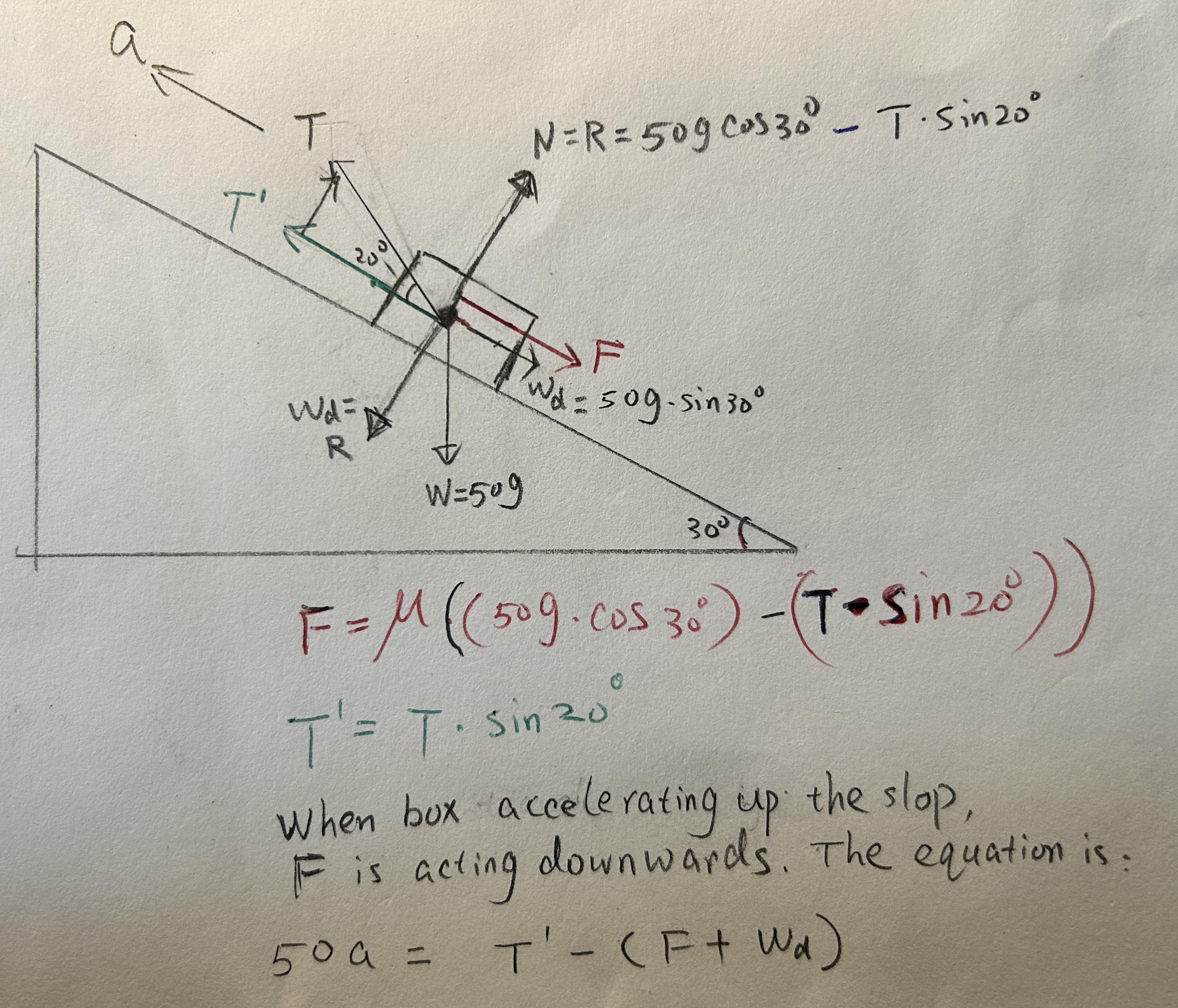
Same as part (a), but now consider the acceleration up the slope. The frictional force will act down the slope in this case.
The Reaction force need to consider the component of T perpendicular to the slope.
The Reaction force need to consider the component of T perpendicular to the slope.
Solutions
To find the magnitude of the force
The box is moving up the slope, so the frictional force acts down the slope.
the component of T alone the slope is:
The box is moving up the slope, so the frictional force acts down the slope.
the component of T alone the slope is:
The net force
The equation of motion along the slope is:
Substituting the known values:
Solving for
Now, solving for
Calculating the right side:
Calculating the left side coefficient:
Thus,
- George pulls a crate of mass
across a rough horizontal floor using a light inextensigle string which makes an angle to the horizontal. The coefficient of fricton between the floor and the box is . The acceleration of the box across the floor is . George models the situation assuming that there are no other resistive forces.
(a) Show that, the tension in the string is given by .
Hint
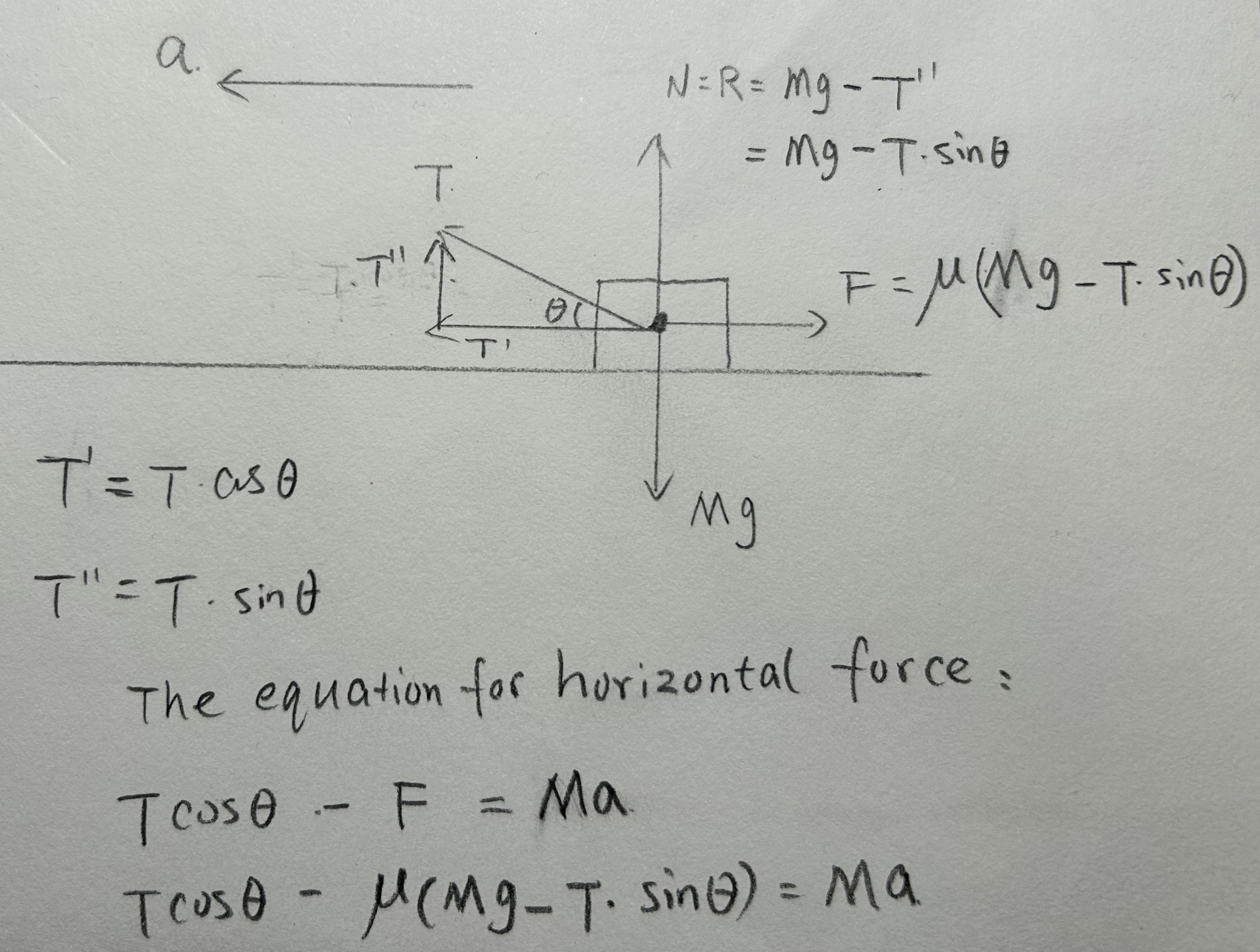
Similar to previous questions, when calculating the friction force, we need to include the vertical component of the tension when calculating the normal reaction force.
Solutions
To derive the expression for the tension
- Vertical Forces:
- The weight of the crate acts downward:
- The vertical component of the tension in the string acts upward:
- The normal reaction force
from the floor acts upward.
The equation for vertical forces is:
Solving for
- Horizontal Forces:
- The horizontal component of the tension in the string acts to the right:
- The frictional force
acts to the left and is given by
The equation for horizontal forces is:
Substituting
Expanding and rearranging gives:
Combining the terms with
Solving for
Factoring out
(b) George knows that when
Hint
When box is about to move, the frictional force is at its maximum value and the acceleration is zero.
Solutions
When box is about to move, the frictional force is at its maximum value and the acceleration is zero. Therefore, we can set
Substituting the known values
Rearranging to solve for
Expanding the left side:
Rearranging gives:
Solving for
Calculating the values:
- Two small blocks of mass 0.8 kg and 1.2 kg are attached with a light inextensible rod which is parallel to the bases of the blocks. The blocks are placed on a plane inclined at
to the horizontal with the 1.2 kg block higher than the 0.8 kg block. The coefficient of friction between the 0.8 kg mass and the plane is 0.5 and that between the 1.2 kg mass and the plane is 0.3 .
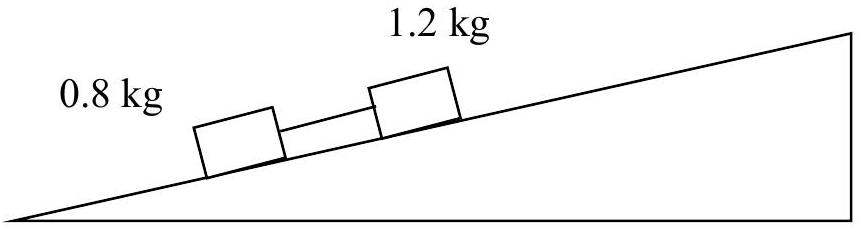
(a) Determine the acceleration of the system.
Hint
Try to work out the frictional forces and downward forces acting on both blocks. The net force on the system will be the difference between the total downward forces and the total frictional forces. Then use Newton’s second law to find the acceleration of the system.
Heavier box is higher, so the system will accelerate down the slope.
Heavier box is higher, so the system will accelerate down the slope.
Solutions
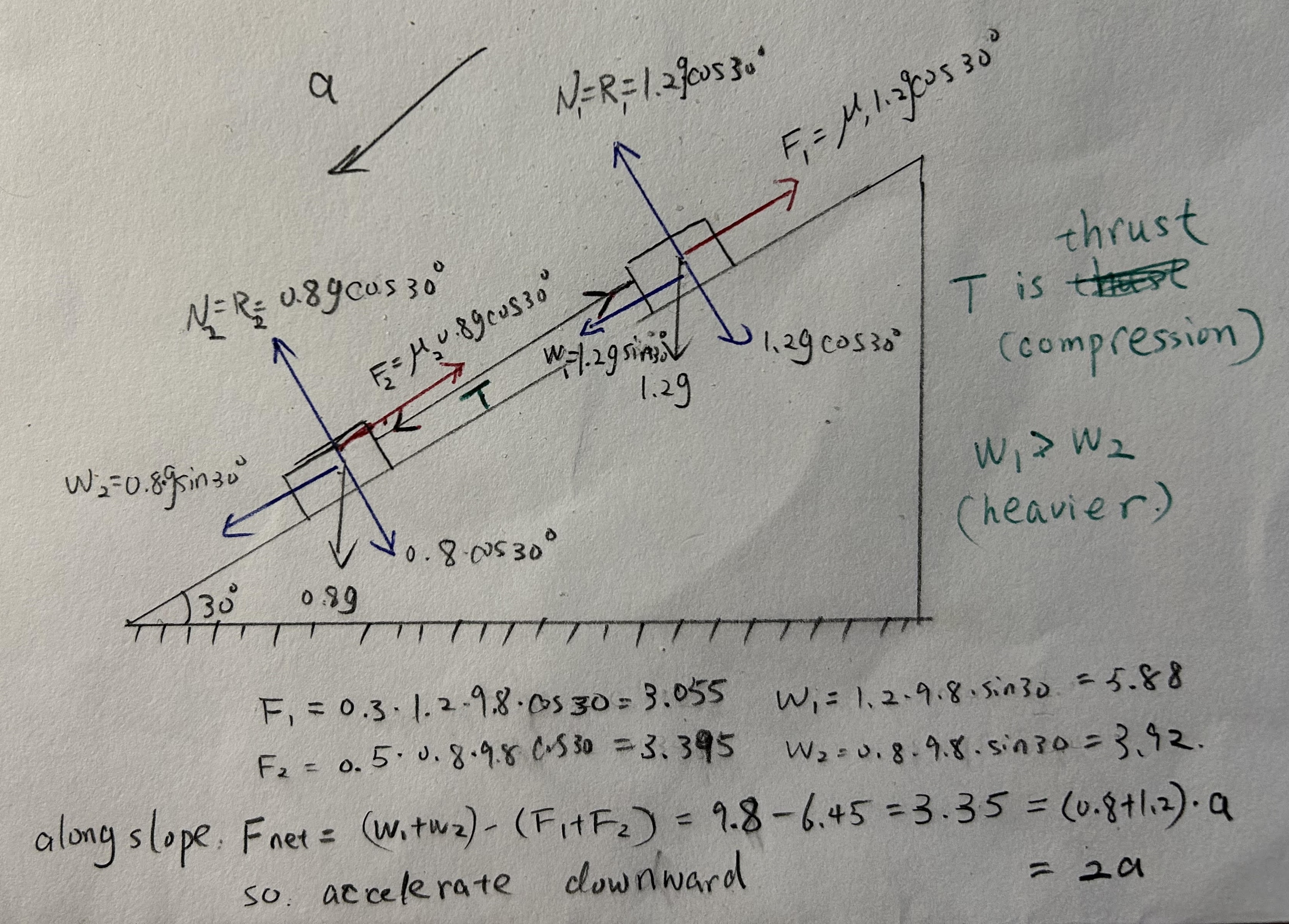
To determine the acceleration of the system, we first need to calculate the forces acting on both blocks.
- For the 0.8 kg block:
- Weight:
- Component of weight down the slope:
- Normal reaction force:
- Frictional force:
- For the 1.2 kg block:
- Weight:
- Component of weight down the slope:
- Normal reaction force:
- Frictional force:
- Net Force on the System:
- Total downward force:
- Total frictional force:
- Net force:
- Acceleration of the System:
- Total mass of the system:
- Using Newton’s second law:
(b) Determine the magnitude of the force in the rod making clear whether it is in tension or compression.
Hint
Since 1.2g box is heavier, the rod will be in thrust (compression). Consider the forces acting on either block and use Newton’s second law to find the force in the rod.
Solutions
To determine the magnitude of the force in the rod, we can analyze the forces acting on either block. Let’s consider the 0.8 kg block.
- For the 0.8 kg block:
- Weight component down the slope:
- Frictional force:
- Acceleration of the block:
Using Newton’s second law for the 0.8 kg block:
The force on Rod is compression (thrust), so we have:
Substituting the known values:
Solving for