Kinematics

Use
- A particle traveling in a straight line at
is brought to rest by a constant deceleration in a distance of 22.5 m . Find the time taken for the particle to come to rest.
Hint
Just use the SUVAT equation that does not involve time to find the acceleration first, then use that to find the time.
Solutions
Using the SUVAT equation
Using
Using
- A plant pot falls from a balcony. It hits the ground after 2.24 seconds.
(a) By modelling the plant pot as a particle, find the height of the balcony from the ground.
Hint
Use the SUVAT equation that does not involve final velocity to find the height.
Solutions
Using the SUVAT equation
(b) State one further assumption used to model this situation.
Solutions
Assume that air resistance is negligible.
- A particle accelerates uniformly from
to in 8 s . How far does it travel in this time?
Hint
Use the SUVAT equation that involves initial velocity, time and acceleration to find the distance. Find the acceleration first using the equation that involves initial velocity, final velocity and time.
Solutions
Using the SUVAT equation
Using
Using
- A particle is projected at a speed of
up a straight inclined track. Whilst on the track the particle experiences a constant acceleration down the track of . Find the length of time that the displacement of the particle up the track from the point of projection is greater than 8 metres.
Hint
Again use the SUVAT equations. Find the time taken to reach 8 metres by rearranging the equation to form a quadratic equation.
There will be two solutions, find the difference between them to get the time spent above 8 metres.
There will be two solutions, find the difference between them to get the time spent above 8 metres.
Solutions
Using the SUVAT equation
Solving this quadratic equation gives
The displacement of the particle up the track from the point of projection is greater than 8 metres for
Solving this quadratic equation gives
The displacement of the particle up the track from the point of projection is greater than 8 metres for
- A train passes through station A tramelling at
along a straight track.
For the first 5 seconds after leaving the station the train has a constant acceleration of
The train then travels with constant velocity for a time, T , until it decelerates uniformly for 15 seconds, coming to rest at the station
Sketch a velocity time graph for the motion of the train and calculate the time taken to get between the two stations.
Hint
There are three phases to the motion: acceleration, constant velocity and deceleration.
Solutions
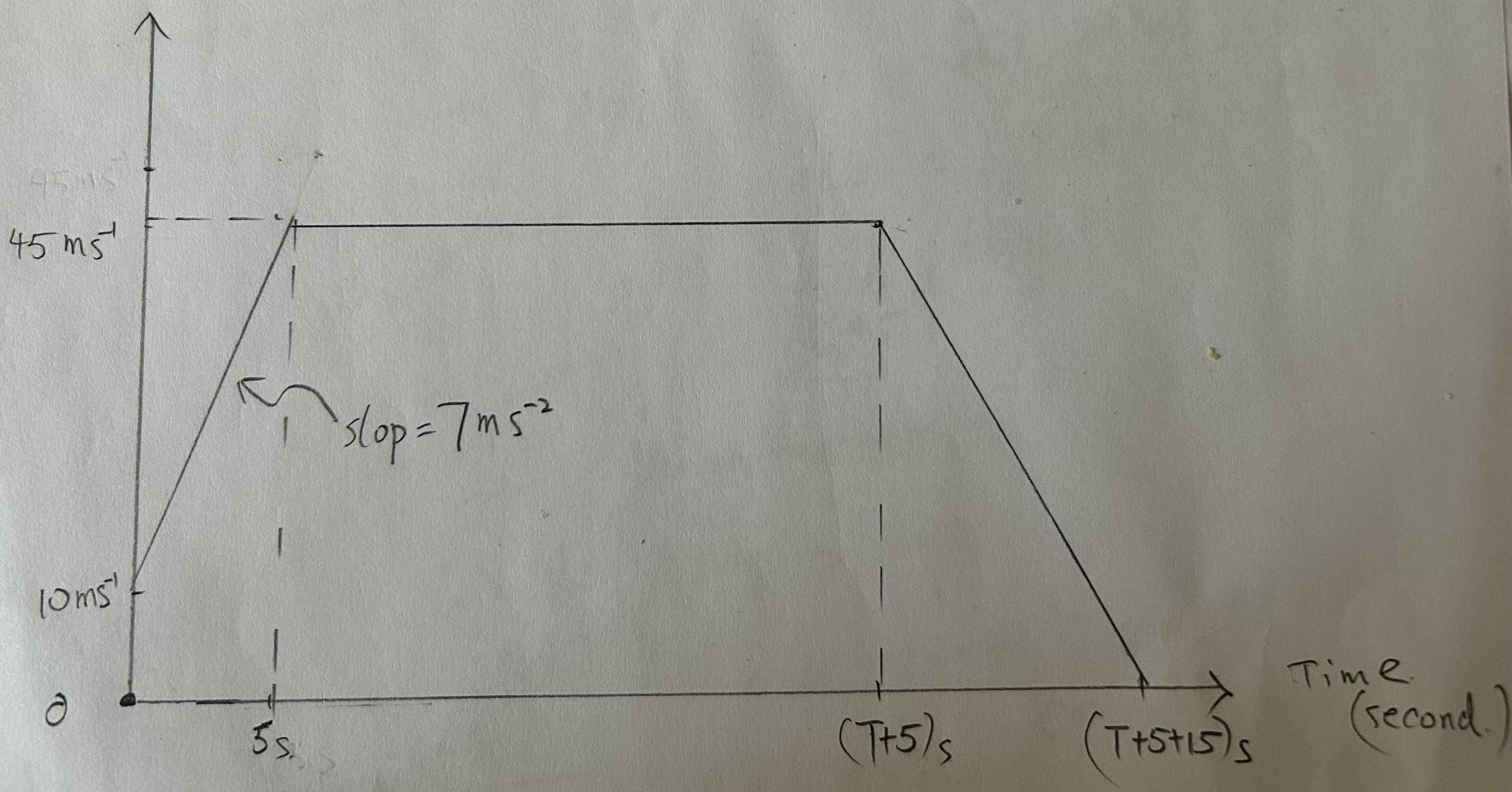
Phase 1 (0 → 5 s): initial speed
Phase 2 (constant velocity): speed
Phase 3 (braking for 15 s to rest):
initial speed
initial speed
Total displacement:
so
Hence
Total time:
Answer: 69 s.
- A particle travels in a straight line.
The motion is modelled by the- diagram below.
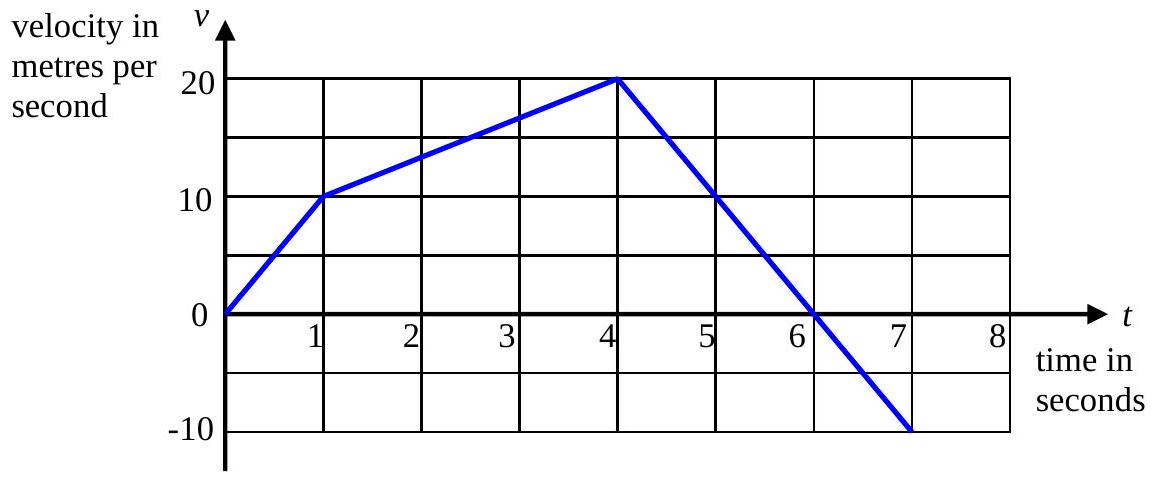
(a) Calculate the acceleration of the particle in the part of the motion fromto .
Hint
The acceleration over that interval is the slope of the v–t graph.
Solutions
The acceleration is given by the gradient of the
From
Therefore, the acceleration is
From
Therefore, the acceleration is
(b) Calculate the displacement of the particle from its position when
Hint
There are three sections above the time axis and one section below it. To calculate displacement, calculate the area of each section and add them up, then subtract the area below the time axis.
Solutions
- A ball A is thrown vertically upwards at
from a point P . Three seconds later a second ball is also thrown vertically upwards from the point at . Taking the acceleration due to gravity to be , calculate
(a) the time for which ball A has been in motion when the balls meet
Hint
Let the time after ball A is thrown when they meet be
The displacements of ball A and ball B are same.
Solutions
Setting
Hence ball A has been in motion for
(b) the height above P at which A and B meet.
Hint
Use either displacement equation for ball A or ball B to find the height when they meet.
Solutions
Considering ball A, the displacement when they meet is:
- Cars A and B are traveling in the same direction along a straight road. The time
is in seconds.
At, car A is at rest. It accelerates at for and then travels at a constant speed.
Car B travels atfor and then accelerates at until it reaches a speed of , after which it continues at this constant speed.
(a) Draw- diagrams for the motion of car A and of car B , where is the speed in and .
Solutions
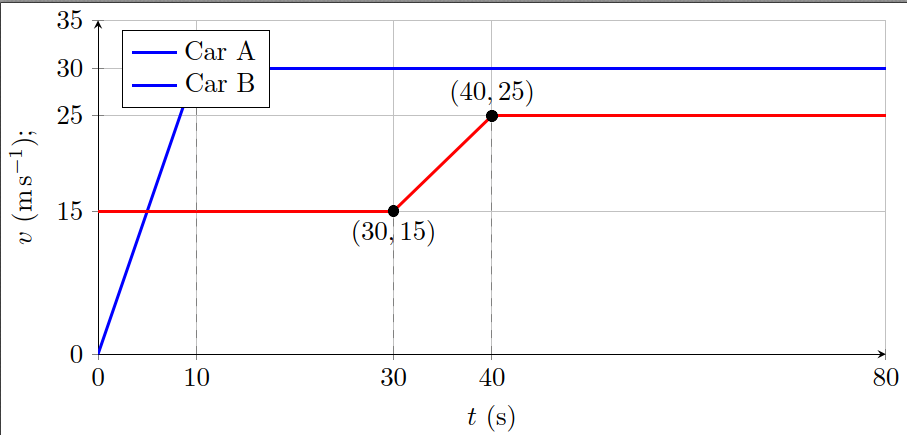
(b) Show that, in the first 40 seconds, car A travels 400 m further than car B.
Hint
Calculate the displacements of each car in the first 40 seconds using the area under the v–t graphs.
Solutions
For car A (accelerates at
For car B (constant
Therefore the difference in the first 40 s is
so car A travels
Hint
From part (b), car A catches up 400 meters at
After that, both cars travel at constant speeds. Find the time taken for car A to close the remaining 100 m gap.
After that, both cars travel at constant speeds. Find the time taken for car A to close the remaining 100 m gap.
Solutions
Given that car A is initially
From the previous kinematic results at
so the separation closed in the first 40 s is
Thus the remaining separation at
For
Time to close the remaining
Hence A catches B at
Therefore car A catches car B at