Parametric Equations

- Find the turning points of the curve with parametric equations
Hint
Differentiate using chain rule:
Set the derivative equal to zero to find turning points.
Solutions
Differentiate
Differentiate
Now, we use the chain rule:
We can simplify this expression:
To find the turning points, we set the derivative equal to zero:
Taking the square root of both sides gives us:
So, the turning points occur at
Now we find the (x,y) coordinates for each value of t:
When
For
For
So, the first turning point is
When
For
For
So, the second turning point is
When
For
For
So, the first turning point is
When
For
For
So, the second turning point is
- A curve is defined by the parametric equations
.
(a) By eliminating the parameter, find the cartesian equation of the curve.
Solutions
The goal of eliminating the parameter is to get a single equation involving only x and y, without t. It’s usually easiest to isolate t from the simpler equation. In this case, equation (2) is perfect for that:
A curve is defined by the parametric equations:
From y=4t, we can solve for t:
Now, substitute this expression for
Let’s simplify the expression to get our final Cartesian equation:
We can also rearrange this to:
(b) Find, in the form
Solutions
A curve is defined by the parametric equations:
We want to find the equation of the tangent to this curve at point A, where
We want to find the equation of the tangent to this curve at point A, where
Step 1: Find the coordinates of point A
First, we determine the
Substitute
So, the point A is
First, we determine the
Substitute
So, the point A is
Step 2: Find the derivative
To find the slope of the tangent line, we calculate
To find the slope of the tangent line, we calculate
First, let’s find
Now, substitute these into the formula for
Step 3: Calculate the slope of the tangent at point A
The slope of the tangent line at point A is the value of
The slope of the tangent line at point A is the value of
Step 4: Use the point-slope form of a line
We have the point A
We have the point A
Substitute the values:
Step 5: Convert the equation to the form
To remove the fraction and rearrange the terms, multiply both sides by 2:
Now, move all terms to one side to match the
To remove the fraction and rearrange the terms, multiply both sides by 2:
Now, move all terms to one side to match the
- A line segment is defined by the parametric equations
(a) Find
Solutions
Differentiate with respect to
Form the quotient
(b) Find the cartesian equation of the line segment, stating its domain.
Solutions
Method 1: Eliminate the parameter
Eliminate the parameter using the identity
Eliminate the parameter using the identity
Substitute
Rearranging gives the line equation in standard form:
Method 2: Use the derivative and point-slope form
From part (a), we have
When
From part (a), we have
When
So, the point is
Substituting the point
Domain
Regarding the domain, since
Regarding the domain, since
- A circle is defined by the parametric equations
.
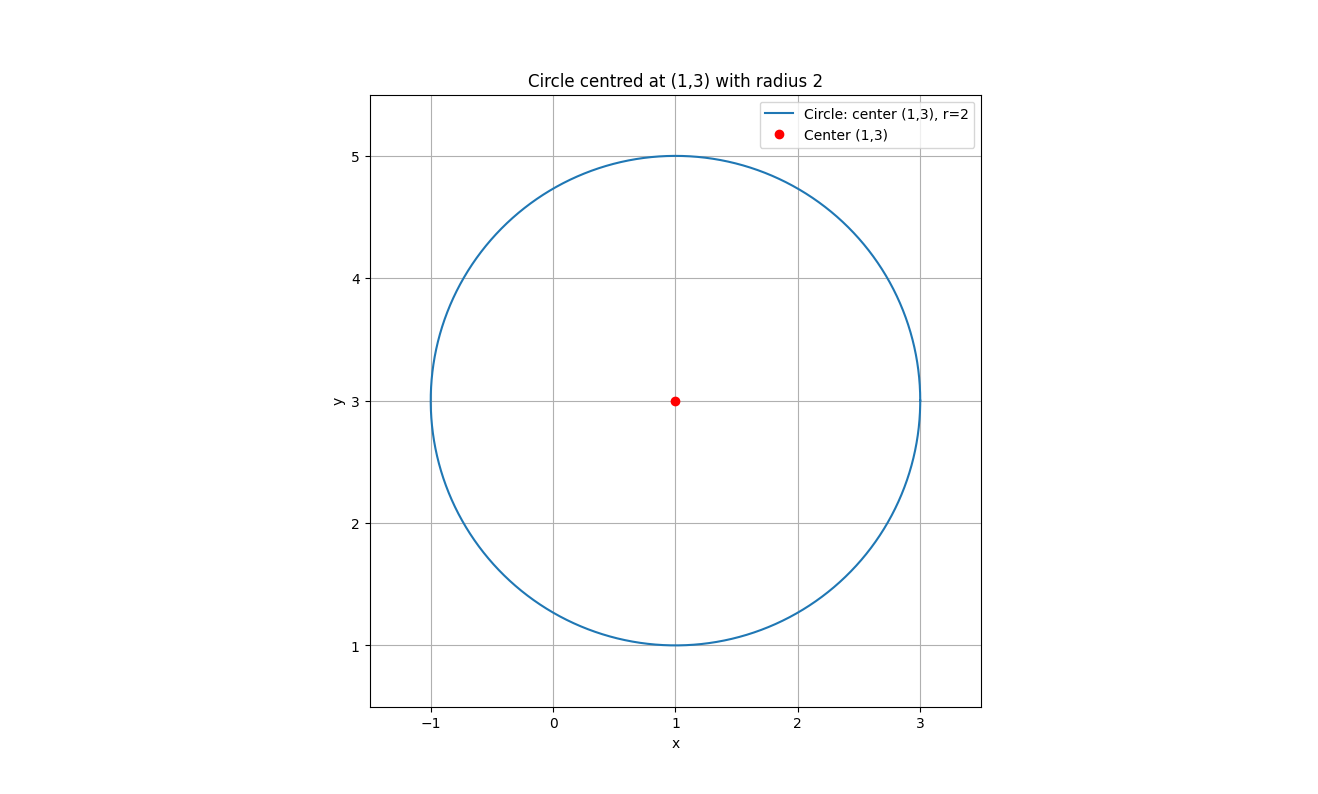
(a) Sketch the circle.
Solutions
a circle centred at (1,3) with radius 2
(b) Find
Solutions
Differentiate with respect to \theta:
Hence
valid for
Hint
Any point on the curve can be written as
Substitute the values of
Substitute the values of
Solutions
Parametric equations
Point on the curve
The point is
The point is
Derivatives
Slope
Point-slope form
Multiply both sides by
Substitute (
Expand and rearrange
Use identity
(d) Find the coordinates of the point where
Solutions
Plug in
we get
So the point is
(e) Find, in the form
Hint
Normal line has slope that is the negative reciprocal of the tangent slope. Substitute the
Solutions
The parametric equations are
At
hence the point is
The slope of the tangent is
Thus the slope of the normal is the negative reciprocal:
The normal line through
Rearrange to the form
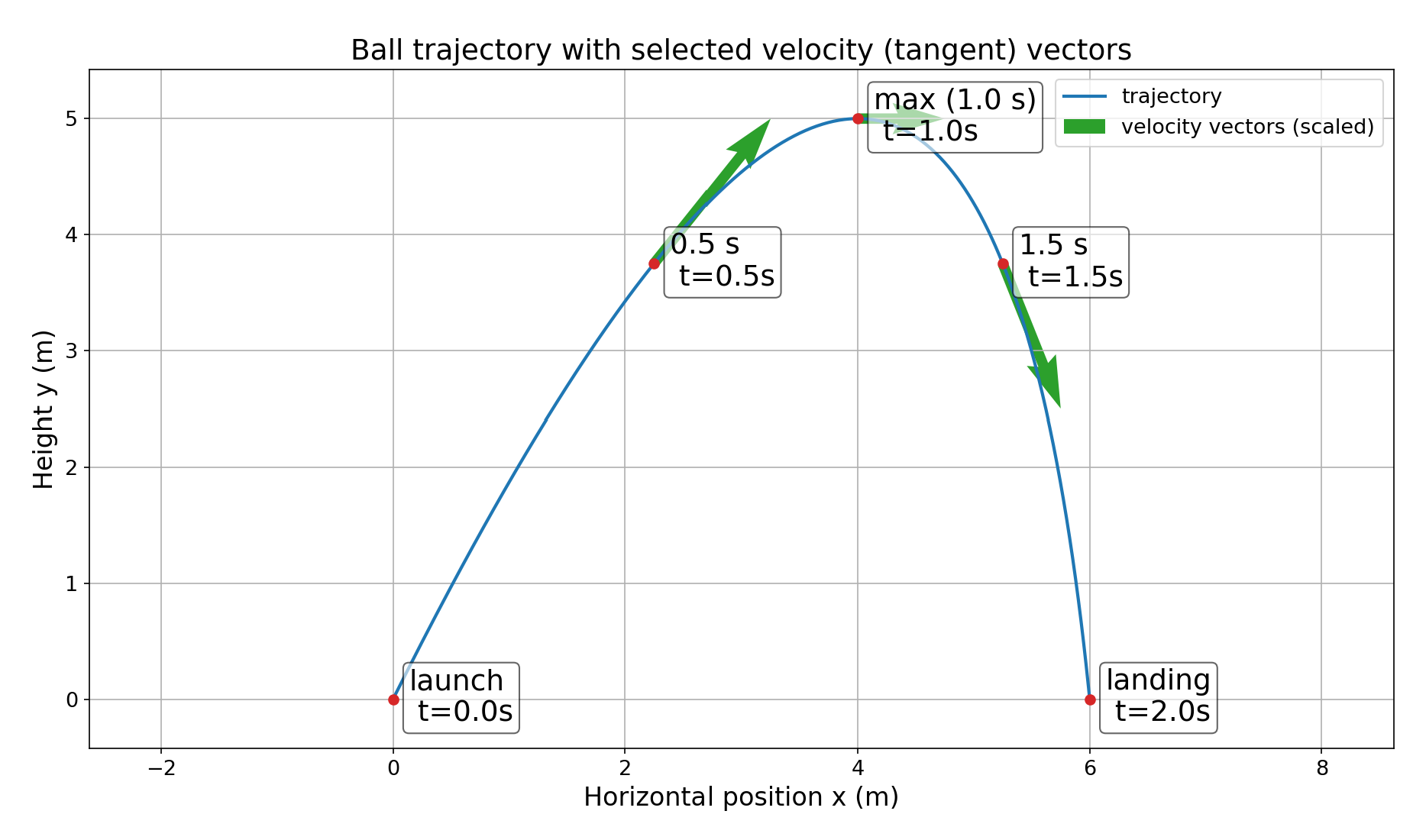
- A ball is thrown from a fixed point O on a windy day. At time t seconds after it is thrown, the vertical displacement
metres and the horizontal displacement metres of the ball from can be modelled by the parametric equations:
(a) Use this model to find the position of the ball after 0.8 s
Solutions
The parametric model is
Evaluate at
Therefore the position of the ball after
(b) Use this model to find the height of the ball when it has travelled a horizontal distance of 2.25 m
Hint
Solve for t from the horizontal equation, then find y.
Solutions
Solve for t from the horizontal equation, then find y.
Rearrange:
Compute the discriminant:
so
This gives (t=4.5) and (t=0.5). Only (t=0.5) lies in the allowed interval
Now compute the height:
Now compute the height:
The height is 3.75 m when the ball has travelled 2.25 m horizontally.
Hint
Find the maximum height by differentiating y with respect to t, setting the derivative to zero, and solving for t. Then substitute this t value into the x equation to find the horizontal displacement.
Solutions
Find when the height is maximum, then evaluate the horizontal position there.
The vertical displacement is
Differentiate to find the maximum:
Set this to zero to get the time of maximum height:
Now evaluate the horizontal displacement at this time:
(d) Explain the significance of the domain of the parametric equations,
Solutions
t=0 represents the time when the ball is thrown from point O, and t=2 represents the time when the ball lands back on the ground. Therefore, the domain
If t<0, it would represent a time before the ball was thrown, which is not relevant to the motion being modeled. If t>2, it would represent a time after the ball has already landed, which is also not relevant to the motion being modeled.
If t<0, it would represent a time before the ball was thrown, which is not relevant to the motion being modeled. If t>2, it would represent a time after the ball has already landed, which is also not relevant to the motion being modeled.
(e) Later in the day, the wind strength increases. It is still blowing from the same direction and the ball is still thrown with the same velocity. Explain how you could refine the model to reflect the change in conditions.
Solutions
Wind strength increase can be modelled by acceleration in the horizontal direction. We can calculate the the starting velocity based on acceleration, and velocity can be used to find the new position in the horizontal direction.
No change in vertical motion.
No change in vertical motion.