Forces and Motion

- A box of mass 4 kg rests on a rough plane inclined at
to the horizontal.
(a) Calculate the magnitude of the normal reaction between the box and the plane.
Hint
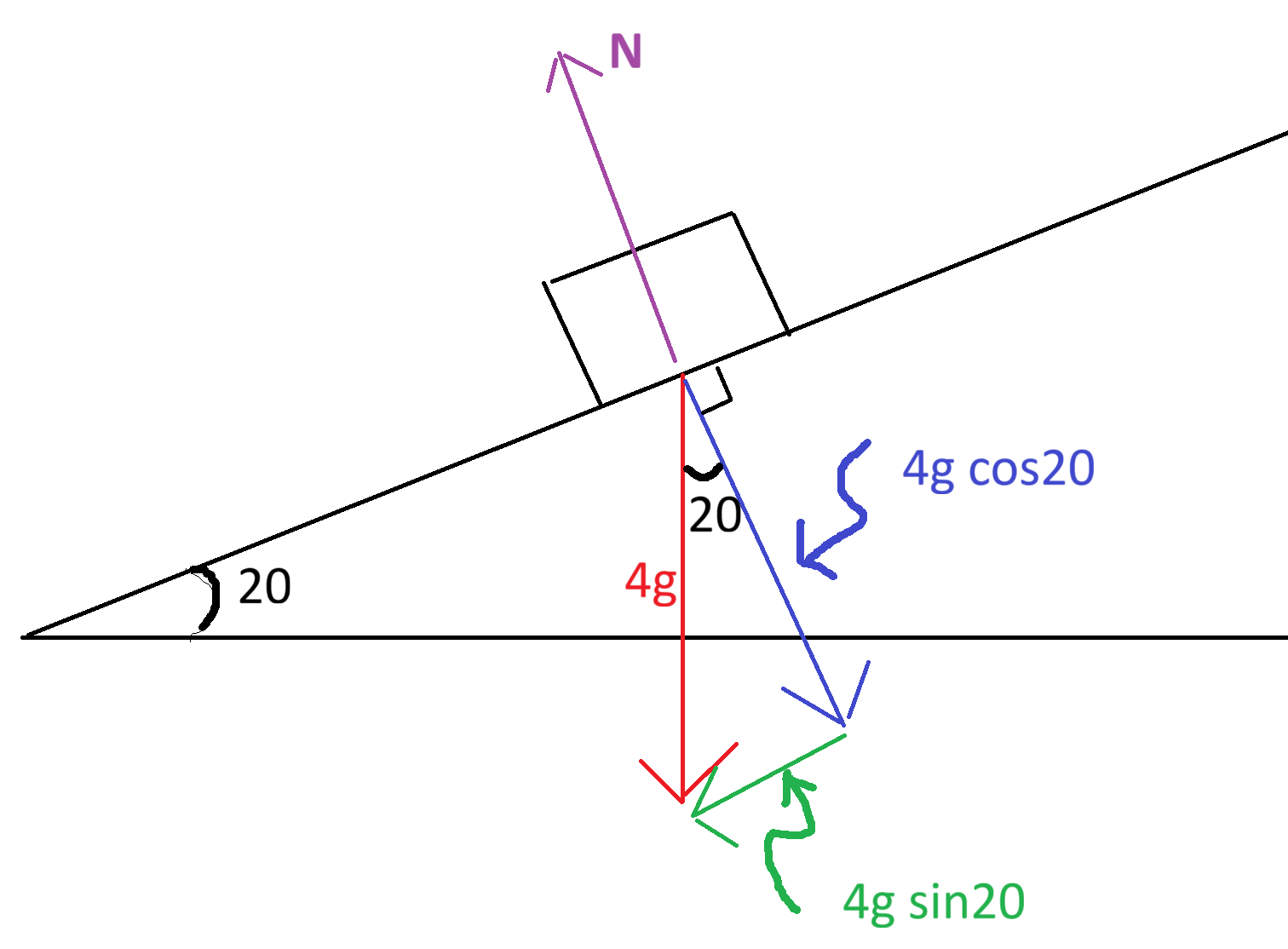
Solutions
The weight of the box is given by
The normal reaction
The normal reaction
It is asked to calculate the magnitude of the normal reaction, so the answer is:
(b) Calculate the magnitude of the frictional force between the box and the plane, indicating the direction clearly.
Hint
The component of the weight parallel to the inclined plane can be calculated using:
Solutions
The component of the weight parallel to the inclined plane is given by:
Since the box is at rest, the frictional force must balance this component. Therefore, the magnitude of the frictional force is
- A particle P of mass 3 kg is suspended by two strings inclined at
and to the horizontal as shown in the diagram. Calculate the tensions in the strings PA and PB.

Hint
Resolve the forces vertically and horizontally for tension A and B. The vertical components must sum to the weight of the particle, and the horizontal components must balance each other.
Solutions
Let the tension in string PA be
Resolving the forces vertically and horizontally, we have:
- Vertical components:
- Horizontal components:
From the horizontal equation, we can express
Substituting this into the vertical equation:
With the values of
Solving for
Now substituting
Therefore, the tensions in the strings are approximately:
- Tension in string PA:
- Tension in string PB:
- A sledge of mass 5 kg is pulled over a frozen lake by a string at
to the horizontal. The tension in the string is 20 N . There is a resistance to motion of 7 N . Calculate the acceleration of the sledge.
Hint
Solutions
The horizontal component of the tension in the string is given by:
The net force acting on the sledge is:
Using Newton’s second law, the acceleration
Therefore, the acceleration of the sledge is approximately
- A lightbulb of mass 0.1 kg hangs from a wire. A horizontal force of
is applied to the lightbulb so that the angle between the wire and the vertical is .
(a) Draw a diagram showing all the forces on the lightbulb.
Solutions
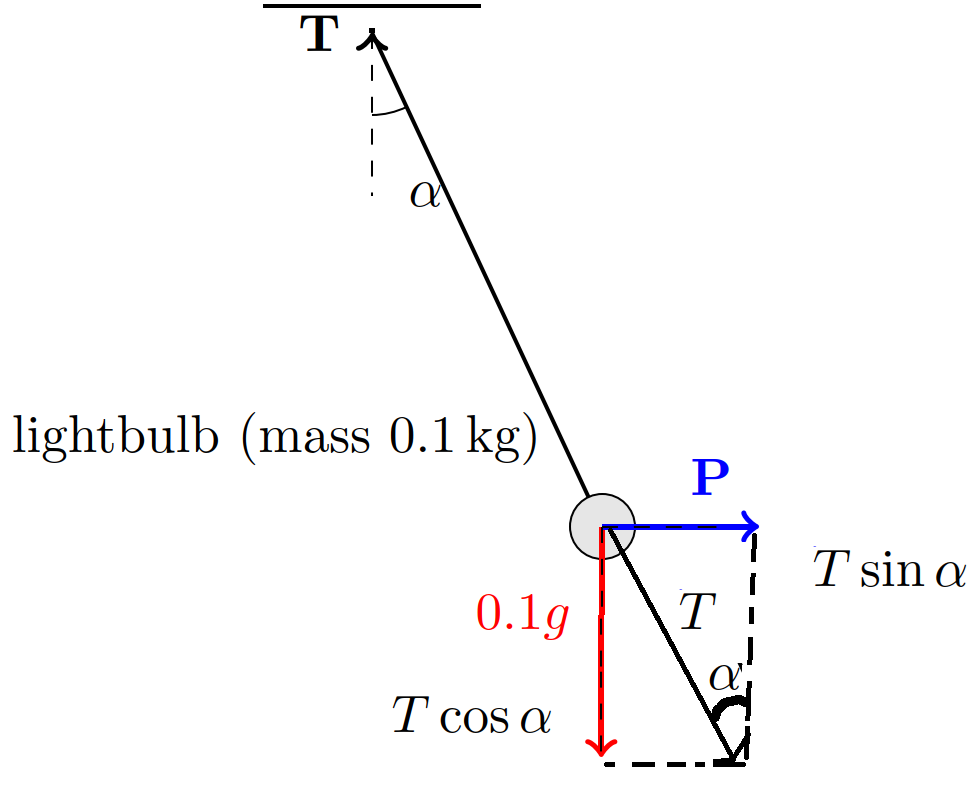
(b) In the case where
Solutions
The weight of the lightbulb is given by:
Resolving the forces vertically and horizontally, we have:
- Vertical components:
- Horizontal components:
From the vertical equation, we can solve for the tension
Solutions
Using the horizontal components equation:
(d) The force
Hint
From the horizontal and vertical components equations, we can express \alpha in terms of
Try to eliminate
Solutions
Using the horizontal components equation:
From the vertical components equation:
Substituting
Rearranging for
- Two boxes of mass 20 kg and 25 kg are connected by a rope and are to be pulled up a smooth slope inclined at
to the horizontal with the 20 kg box following the other. The 25 kg box is attached to a cable which is parallel to the plane and passes over a smooth pulley. The other end of a cable is attached to a sack of mass which hangs freely. The sack moves downwards with an acceleration of .
(a) Draw a diagram to show all the forces acting on the boxes and the sack.
Solutions
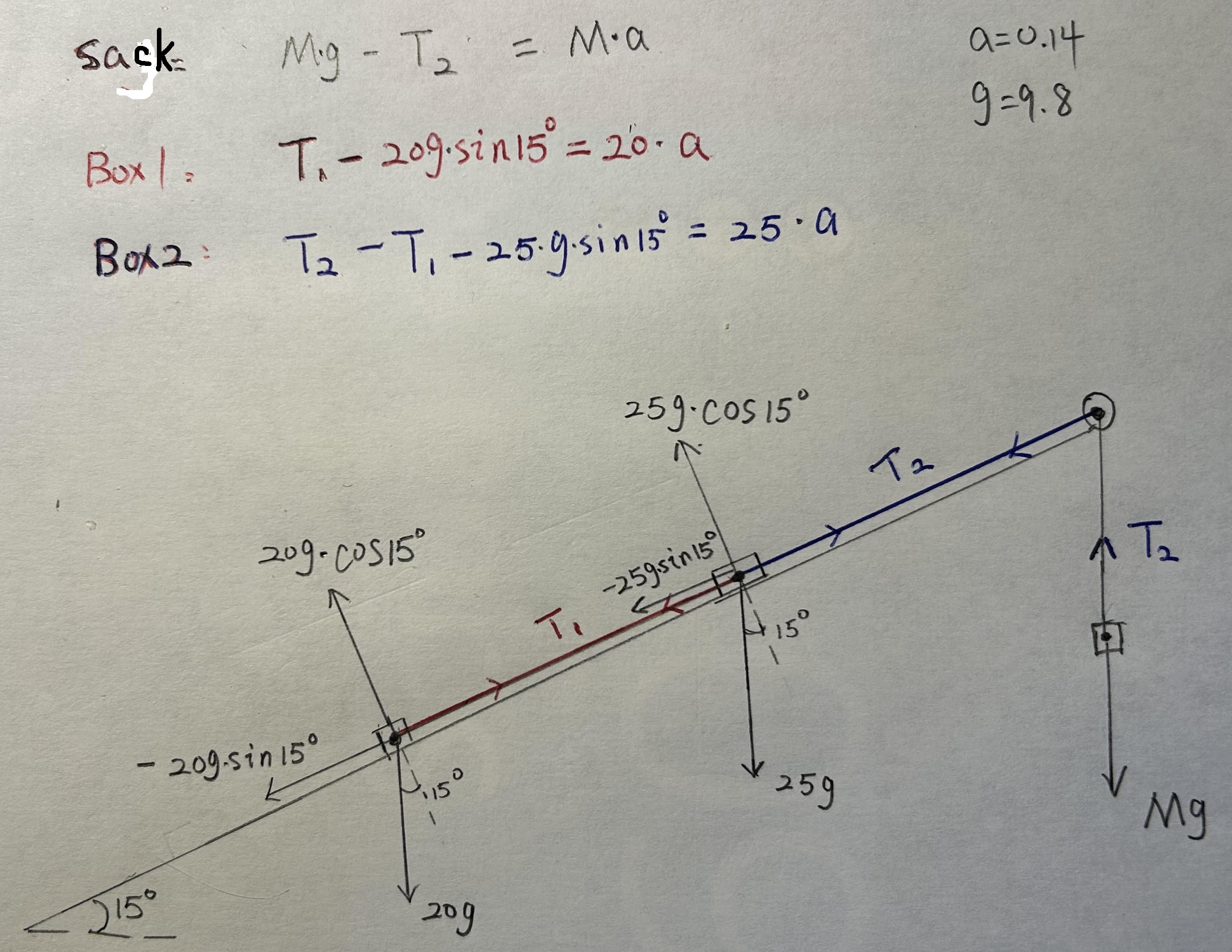
(b) Calculate the tension in the rope between the two boxes.
Hint
Start with the equations of net force for box1, box2 and the sack. Use Newton’s second law
Net force is given by:
Net force is given by:
- For box 1:
- For box 2:
- For the sack:
Solutions
To find the tension in the rope between the two boxes, we first need to analyze the forces acting on each box and the sack.
For the 20 kg box:
The weight component down the slope is
The net force acting on the 20 kg box is given by:
For the 20 kg box:
The weight component down the slope is
The net force acting on the 20 kg box is given by:
For the 25 kg box:
The weight component down the slope is
The net force acting on the 25 kg box is given by:
The weight component down the slope is
The net force acting on the 25 kg box is given by:
For the sack:
The weight of the sack is
The net force acting on the sack is given by:
The weight of the sack is
The net force acting on the sack is given by:
We can solve these equations simultaneously to find the tensions
For the 20 kg box, we can just use equation [1] to find
For the 20 kg box, we can just use equation [1] to find
Hint
Use the equation for the sack and the tension
Calculate
Calculate
Solutions
Using the tension
Substituting
Now, using the sack equation:
Substituting
Rearranging gives:
(d) In practice the acceleration of the system with these masses is less than
Solutions
In practice, the acceleration of the system may be less than
- Friction: The slope and pulley may not be perfectly smooth, leading to frictional forces that oppose the motion of the boxes and the sack.
- Air Resistance: The movement of the boxes and sack through the air may encounter air resistance, which would reduce the net force acting on the system.
- Non-ideal Pulley: The pulley may have some friction in its bearings, which would also reduce the tension in the rope and thus the acceleration of the system.
These factors would need to be included in the model to more accurately predict the acceleration of the system.
- The diagram shows a particle P of mass
suspended from two strings. The strings pass over smooth pulleys A and B and attach to hanging particles. The masses of particles below and are 2 kg and 3 kg respectively. The strings to and make angles of and to the horizontal as shown in the diagram.

(a) Calculate the value of.
Hint
The horizontal components of the tensions applied on particle P must balance each other, and the force on the string is equal to the weight of the hanging particles. Use these relationships to set up equations and solve for
Solutions
To find the value of
Let the tension in the string passing over pulley A be
The weight of the hanging particles are:
Let the tension in the string passing over pulley A be
The weight of the hanging particles are:
- For the 2 kg particle:
- For the 3 kg particle:
Resolving the forces vertically and horizontally for particle P, we have:
- Vertical components:
- Horizontal components:
From the horizontal equation, we can express
Substituting this into the vertical equation:
Using the values of
To find
For pulley A:
For pulley A:
For pulley B:
Substituting
Solving for
(b) Calculate the value of
Hint
The vertical components of the tensions must sum to the weight of particle P. Use this relationship to set up an equation and solve for
Solutions
Using the vertical components equation:
Substituting
Calculating the left side:
Solving for
Hint
The total force exerted on pulley B is the vector sum of the tensions in the strings connected to it. The tensions are
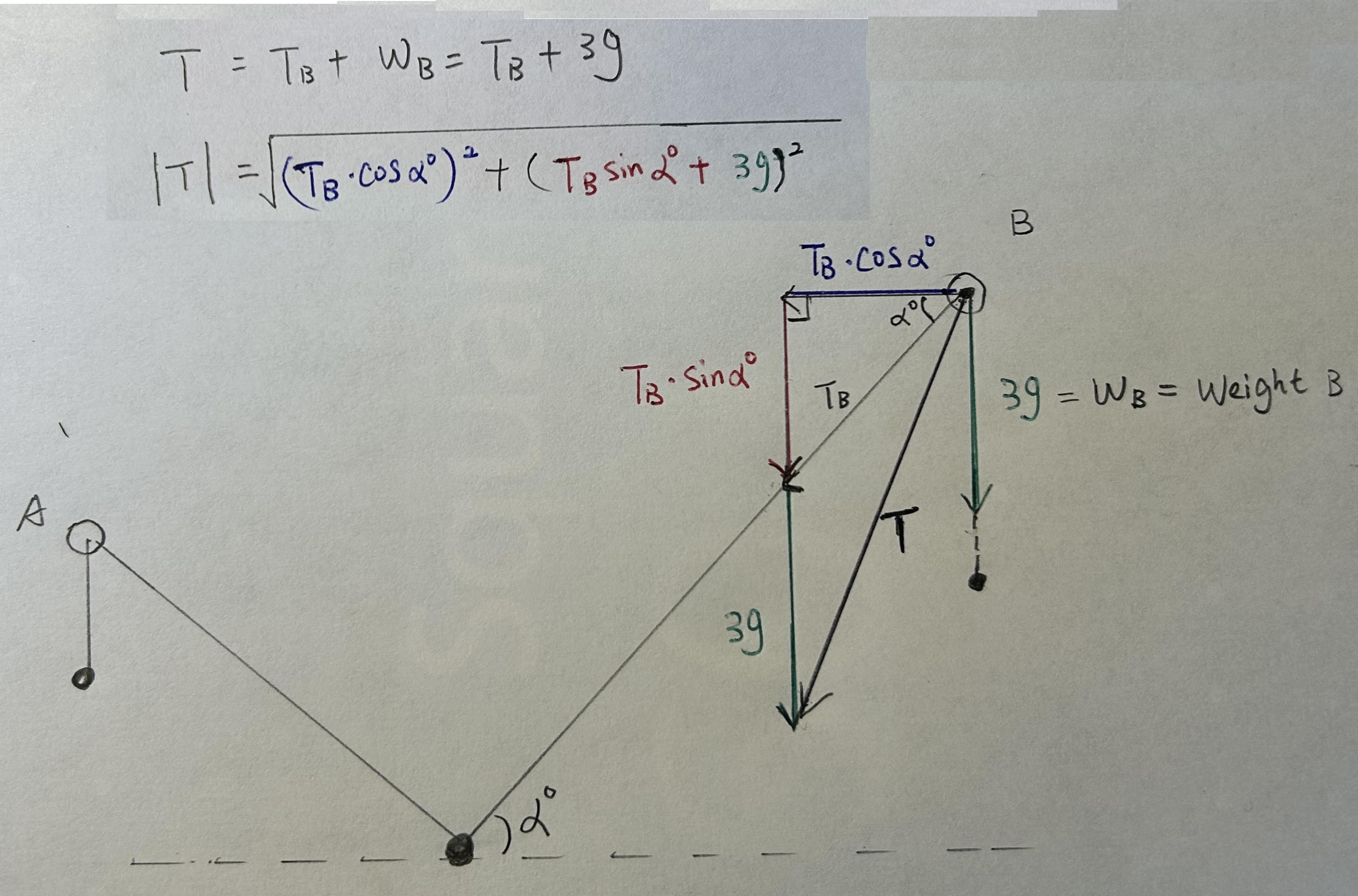
Solutions
The total force exerted on pulley B is the vector sum of the tensions in the strings connected to it. The tensions are
The magnitude of the total force
Substituting the values:
Calculating the components:
(d) Additional weights are attached to the particles below A and B. Explain what will happen to the particle P.
Solutions
If additional weights are attached to the particles below pulleys A and B, the tensions in the strings will increase. This will result in a greater upward force acting on particle P.