Forces and Newton's Laws

Use
- A particle is moving with constant velocity. Three forces
and act on the particle, where and . Find the values of and .
Hint
Since it is moving with constant velocity, the net force is zero. Therefore, the sum of the forces must equal zero.
Solutions
The forces are
For constant velocity the net force is zero, so
Equating components gives
Solving these,
Therefore
- (a) Calculate the acceleration of an object of mass 150 kg subject to a net force of 60 N .
Hint
Use Newton’s second law, which states that the acceleration
Solutions
Using Newton's second law,
With
Therefore the acceleration is
(b) A load of mass 150 kg is accelerating vertically upwards as the result of the pull of a crane wire. The tension in the wire is 1488 N .
Assuming that the only forces acting on the load are its weight and the tension in the wire, calculate the acceleration of the load.
Assuming that the only forces acting on the load are its weight and the tension in the wire, calculate the acceleration of the load.
Hint
Calculate the weight of the load first, then find the net force acting on the load. Finally, use Newton’s second law to find the acceleration.
Solutions
Given a load of mass
The weight is
The net upward force is
By Newton’s second law, the acceleration is
Therefore the acceleration of the load is
- A car of mass 1500 kg is pulling a trailer of mass 900 kg along a straight, horizontal road. The coupling between the car and the trailer is light, rigid and horizontal.
The motion of the car and trailer is modelled assuming that the resistances to motion are negligible. There is a driving force of 600 N acting on the car.
(a) Draw separate diagrams showing the horizontal force(s) acting on
(i) the car.
(a) Draw separate diagrams showing the horizontal force(s) acting on
(i) the car.
Solutions
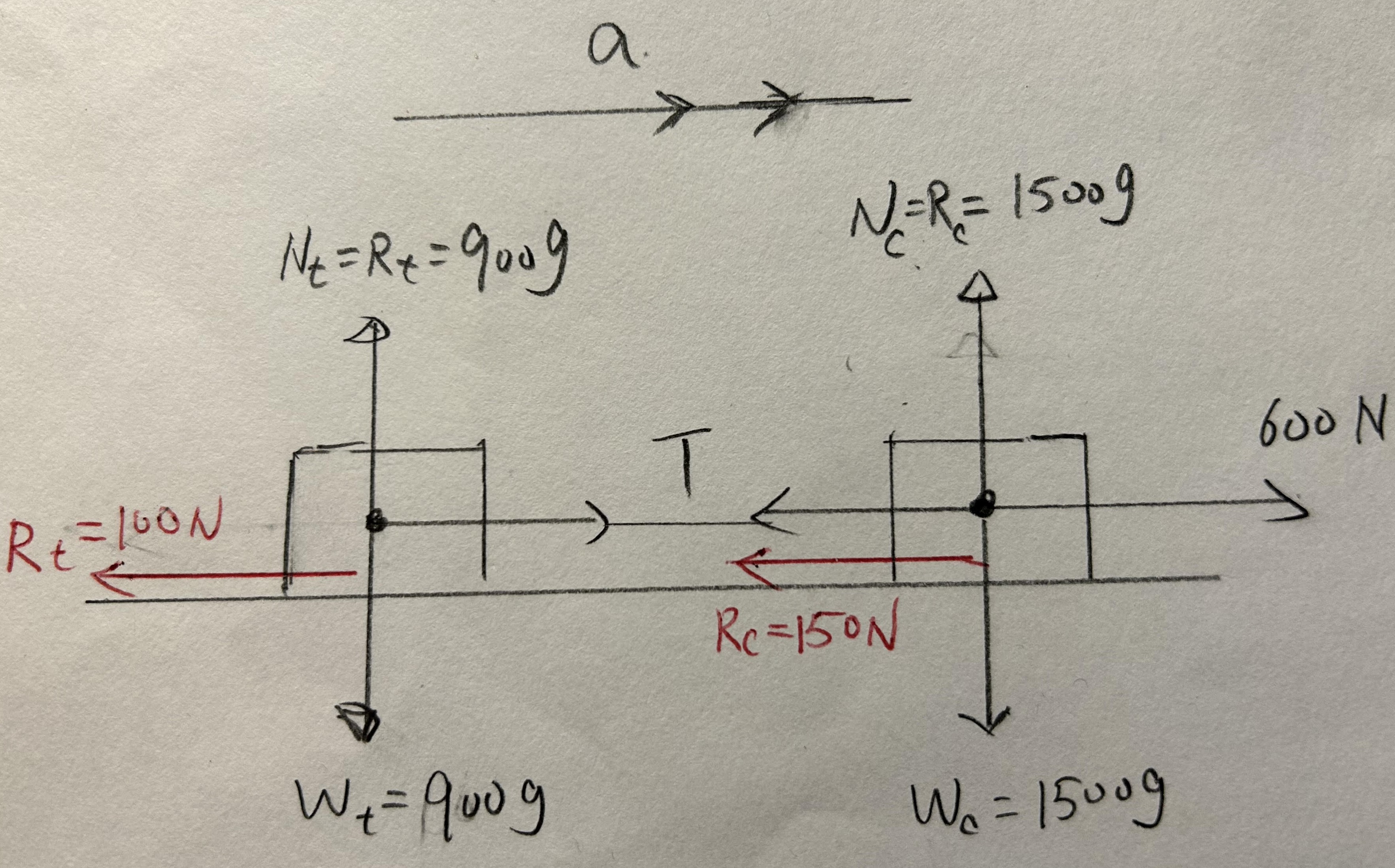
(ii) the trailer.
Solutions
(b) Calculate the acceleration of the car and trailer.
Hint
Use Newton’s second law to find the acceleration of the combined mass of the car and trailer.
Solutions
Apply the Newton’s second law to the whole system of car and trailer.
The total mass of the car and trailer is
The driving force is
Using Newton’s second law, the acceleration is
Therefore the acceleration of the car and trailer is
The situation is remodelled to include a constant resistant force of 150 N on the car and 100 N on the trailer.
Hint
Again, use Newton’s second law to find the acceleration of the combined mass of the car and trailer, taking into account the resistant forces. Then, use this acceleration to find the tension in the coupling by considering the forces acting on the trailer.
Solutions
We can use Newton’s second law on whole system to find the acceleration first. Or we can focus on the forces acting on the car or trailer. Here we use the the trailer.
The total resistant force is
The net force acting on the car and trailer is
Using Newton’s second law, the acceleration is
The forces acting on the trailer are the tension
Substituting the known values,
Solving for
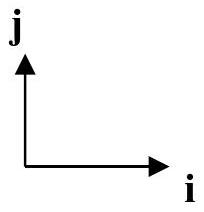
- In this question, the unit vector
is horizontal and the unit vector is vertically upwards. All forces are in Newtons.
A small, heavy box is suspended in mid-air and is held in equilibrium by the tension in a light inextensible string and a horizontal force, as shown in the diagram.
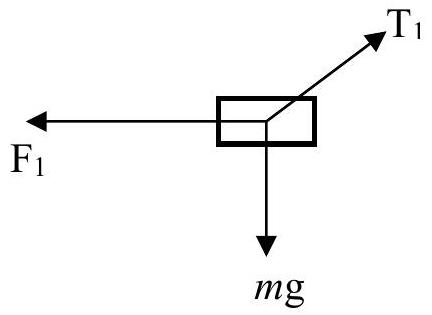
The tension in the string is
(a) Find the value of
(a) Find the value of
Hint
All forces acting on the box must sum to zero since it is in equilibrium. Therefore, the sum of the horizontal components of the forces must equal zero.
Solutions
The forces acting on the box are the tension
where
The horizontal components give:
where
The horizontal components give:
Solving for
Therefore, the value of
Therefore, the value of
(b) Find the mass
Hint
The vertical components of the forces must also sum to zero. Use this to find the weight of the box, and then use the weight to find the mass.
Solutions
The vertical components of the forces give:
where
The weight is related to the mass
where
where
The weight is related to the mass
where
Hint
Use the Pythagorean theorem to find the magnitude of the tension vector. To find the angle, use the tangent function.
Solutions
The magnitude of the tension vector
The angle
Solving for
Therefore, the magnitude of
The angle
Solving for
Therefore, the magnitude of
Another force
(d) The new tension in the string is
(d) The new tension in the string is
Hint
Since the box is still in equilibrium, the sum of all forces acting on it must equal zero. Set up equations for the horizontal and vertical components of the forces and solve for
Solutions
The forces acting on the box are now the tension
where
The horizontal components give:
Solving for
The vertical components give:
Solving for
Therefore, the values of
where
The horizontal components give:
Solving for
The vertical components give:
Solving for
Therefore, the values of
- A girl of mass 48 kg takes a lift from the ground floor up to the second floor. She is holding a package that weighs 5 kg by means of a light inextensible string.
The lift initially accelerates atand then travels at a constant speed of . Finally, the lift decelerates at .
The normal reaction of the floor of the lift on the girl is.
(a) Find the minimum value ofduring the motion.
Hint
Consider the different phases of the lift's motion: acceleration, constant speed, and deceleration. The minimum value of $R$ will occur during the deceleration phase. Use Newton's second law to find $R$ during this phase.
Thw
Solutions
Calculate the normal reaction
-
During acceleration (
):
-
During constant speed (
):
-
During deceleration (
):
The minimum value of
(b) Given that the string does not break during the motion, find the maximum tension in the string during the motion.
Hint
The maximum tension in the string will occur during the acceleration phase of the lift’s motion. Use Newton’s second law to find the tension during this phase.
Similarly, calculate the tension during constant speed and deceleration phases to confirm the maximum value.
Similarly, calculate the tension during constant speed and deceleration phases to confirm the maximum value.
Solutions
Calculate the tension
- During acceleration (
):
2. During constant speed ():
3. During deceleration ():
The maximum tension in the string occurs during the acceleration phase, which is.
- Three particles,
and C , are attached by light inextensible strings AB and BC . Particles A and B are held at an equal height of 2 m above a horizontal floor. B rests on a rough horizontal surface and when in motion experiences a constant resistive force of N. The string passes over two smooth pulleys.
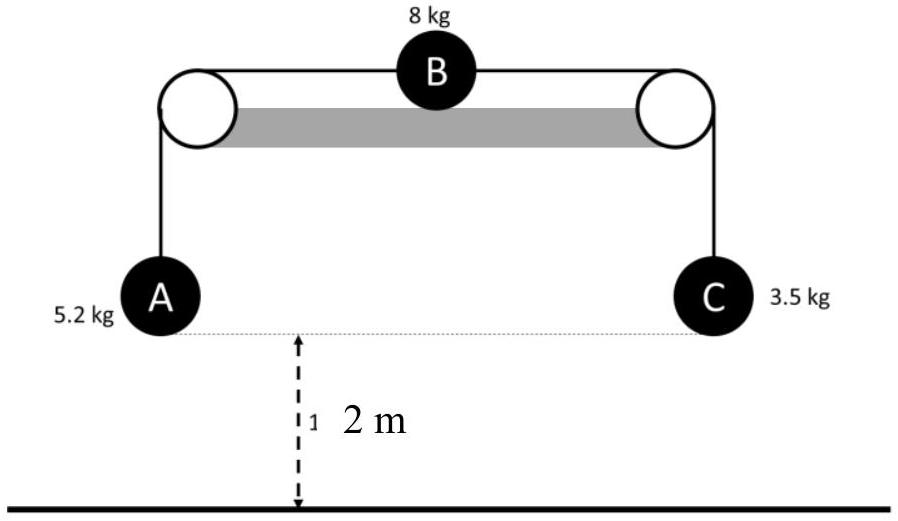
The masses of the particles are
It is given that B does not reach either pulley during any part of the motion following release.
The particles are released and A hits the ground 4 seconds later.
(a) Find the tension in each of the strings AB and BC .
It is given that B does not reach either pulley during any part of the motion following release.
The particles are released and A hits the ground 4 seconds later.
(a) Find the tension in each of the strings AB and BC .
Hint
To find the tension in the strings AB and BC, we first need to determine the acceleration of the system. Since particle A hits the ground after 4 seconds, we can use the kinematic equation to find the acceleration.
Consider the acceleration on the whole system and then analyze the forces acting on each particle to find the tensions in the strings.
Solutions
To find the tension in the strings AB and BC, we first need to determine the acceleration of the system. Since particle A hits the ground after 4 seconds, we can use the kinematic equation to find the acceleration.
The distance fallen by particle A is given by:
where
The distance fallen by particle A is given by:
where
Now, we can analyze the forces acting on each particle to find the tensions in the strings.
For tennsion on string AB:
For tennsion on string AB:
Fpr tension on string BC:
(b) Find the exact value of
Hint
To find the value of
Solutions
To find the value of
Using Newton’s second law for particle B:
Using Newton’s second law for particle B:
Solutions
The assumption that the pulleys are smooth implies that there is no friction between the string and the pulleys, allowing us to analyze the forces acting on each particle without considering any additional forces due to friction at the pulleys.
The particle A detaches from the string as soon as it hits the floor.
(d) Find the acceleration of the system when C is moving downwards.
(d) Find the acceleration of the system when C is moving downwards.
Hint
Basically we can treat the question as new system with only particles B and C.
The friction force
The friction force
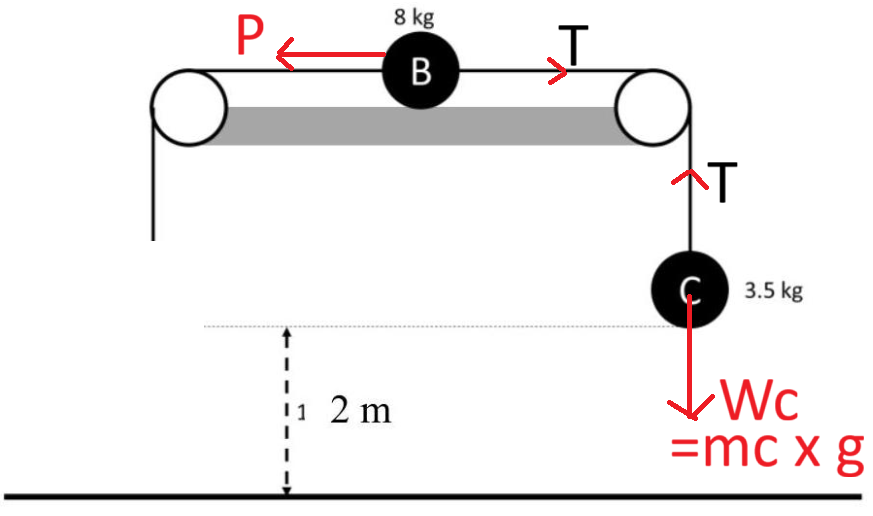
Solutions
Let the acceleration after A detaches (with C moving downwards taken as positive) be
Consider the whole system of particles B and C, the only forces acting on the system are weight of C and friction P toward left, so we have:
Consider the whole system of particles B and C, the only forces acting on the system are weight of C and friction P toward left, so we have:
so
Using the exact values
and
Therefore